Billy Marsh
Designer - He/Him
In Neverpoint the player controls Soul, a being made of pure love, navigating the precarious planets of the timeless universe by using special abilities and unique movement to move from platform to platform. Each planet they’ll visit embodies a specific negative emotion. Jealousy, Hatred, Apathy, Depression and many more feelings of equal severity infest the universe, and it’s up to Soul to push through it all to reach their goal of finding another of their kind. Will love prevail, or will Soul succumb to the negativity that has been wrought in this timeless universe of emotions? Neverpoint is a small introduction to this description, we wanted to develop the game around the theme of grief but didn't have enough time with all in mind, so we made a large level as a vertical slice of what the gameplay and tone would have offered.
My involvement with this project was paired puzzle and level design development, working alongside the writer to help implement narrative into the game and as well as some infrequent programming and art asset production here and there.
Neverpoint
Puzzle Design
Designing the puzzles for Neverpoint was a really fun process, we wanted to make sure the player was getting a good grasp for the new mechanics being slowly introduced to them without sending them through a boring tutorial. This means we worked the ideas into the levels naturally making sure to consider narrative, below are some diagrams that show two of the onboarding puzzles in the game teaching the player how to use the dash mechanic. For context on how the dash mechanic works; The player will hold down 'Left Click' for a set amount of time, depending on the amount of time the strength of the dash will vary, then once 'Left Click' is released the player will dash toward the mouse.
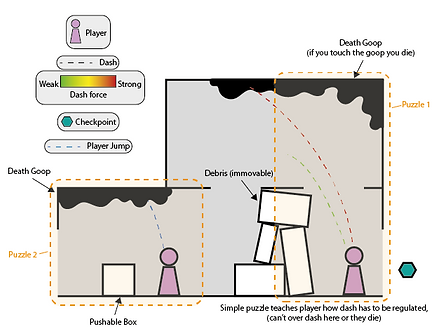
This puzzle was one of the first obstacles the player faced after receiving the dash mechanic. It simply taught the player that the longer they held the dash the stronger the dash is. Essentially, they learn this through trial and error, should the player dash to far they'll hit the 'death goop' and restart. It helps the player understand that the dash needs to be controlled and lets the player figure this out themselves. Generally, players found this way to be a lot more rewarding than just being shown in a tutorial.
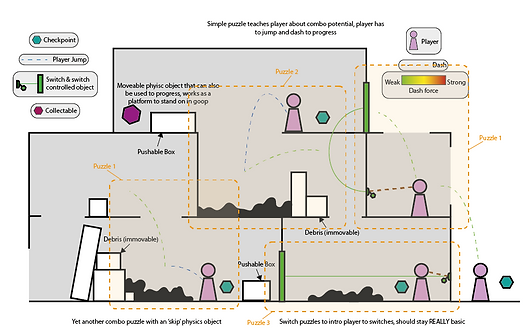
This puzzle is a trickier one that the player finds later on after getting the dash. this puzzle teaches the player to use a combination of their jump with the dash. parts of this puzzle force the player to have to do both, as an example the part to the left the player has to jump to put themselves in the right angle to dash upwards without being hit and blocked by the ceiling. This puzzle also had multiple solutions for the player if they were struggling with certain parts. The jump dash part in the top middle gives the player the option to push a box down and stand on that in case they struggle to complete it with the jump dash method.
Level Design
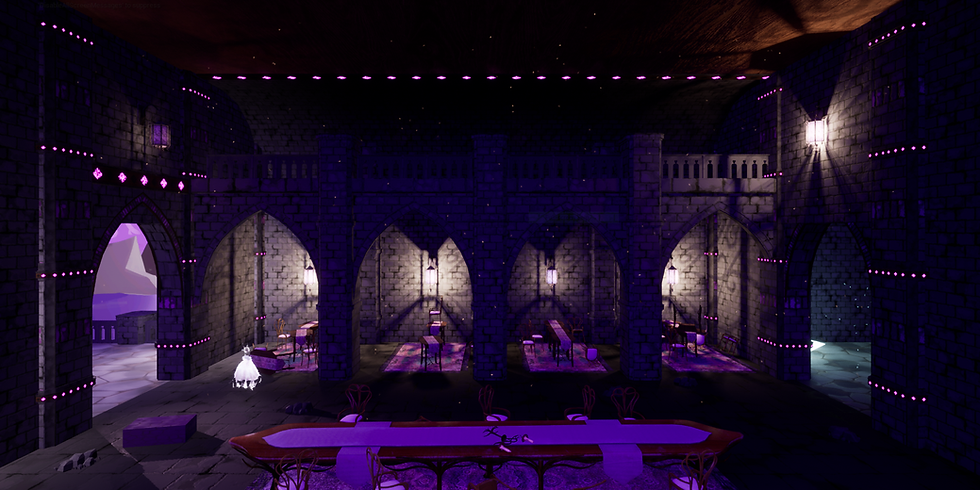
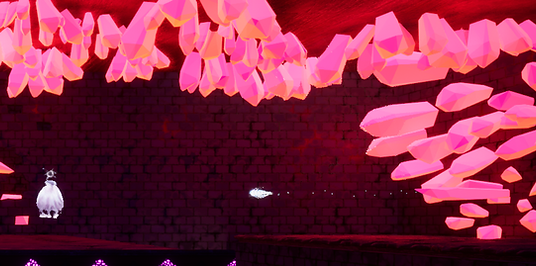
Gameplay screenshots from Neverpoint

Gameplay screenshots from Neverpoint
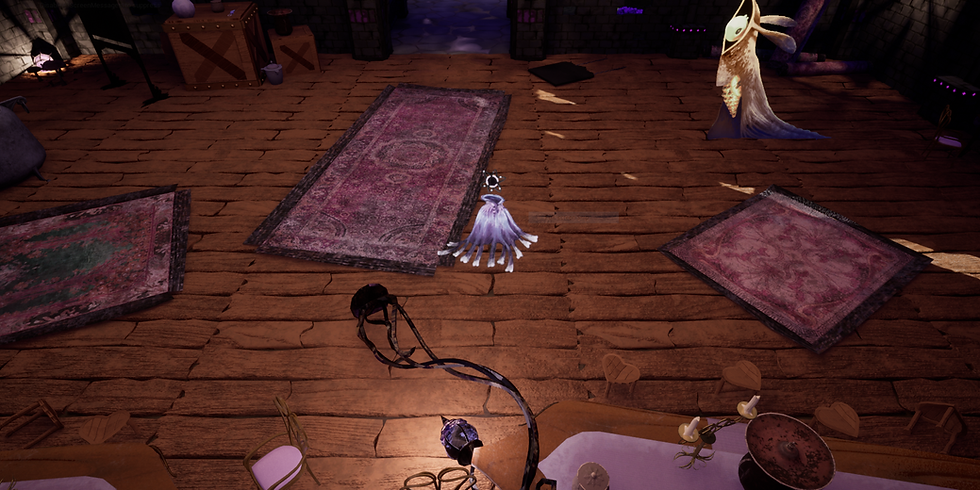
Gameplay screenshots from Neverpoint
Gameplay screenshots from Neverpoint
Narrative Design
Our jobs when designing the narrative involved working with the writer to help them understand what bits of writing were necessary to demonstrate the vision we had for the project as well as taking into account artists concepts and programmers mechanics. Then after the writer was done writing lore and story for the game, we worked this into the map using props and small lore dumps in the form of journals.
The way the player experiences the story is very subtle, the map tells most of it through the awesome 3D assets made by our artists and the way these are placed in-game, it leaves the player asking questions as to why certain things are in certain places and leaves a hint of mystery for the player to discover.
planned in the game through combining some of these ideas and elements together within certain rooms.
With Neverpoint being a narrative driven experience, the levels were all designed to stick within that narrative. When we started designing and making levels, we had to consider how each part of the map might play into the story and how those areas might've been used in this world. We also wanted to give the writer space to explore ideas and themes, this means we decided to try and incorporate a lot of different spaces to fit the narrative on top of designing spaces that allowed the player to explore the games mechanics. We managed to get what we
Extra Bits and Bobs
Then I briefly helped lighten our artists workload by creating some 3D assets, we needed some deathly crystals, so I made a set of red crystal shards and arranged them differently in 9 separate prefabs to give more of a variation. Then I used Unreals visual shader scripting to create a material that glows and has a simple outline with a darker shade.

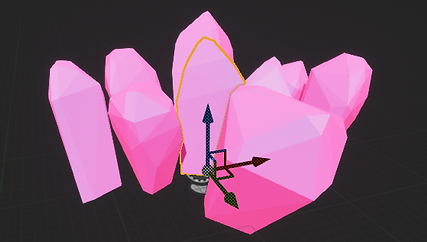
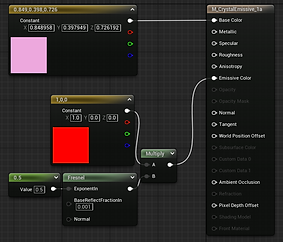
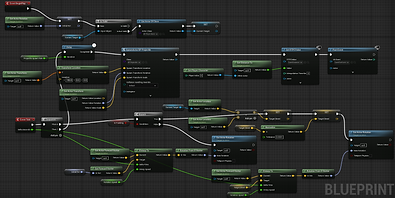
Making the turret was a good learning curve as I hadn't used Unreal before this project, so Unreals visual scripting language was completely new to me. I learnt how to code the turret so it shot projectiles on repeat, these projectiles could kill the player should they make contact. Then I coded the turrets to have the option of pointing toward the player if needed. I had to make the projectiles as a separate object that the turrets just instance, so the projectile is also a whole prefab with its own coding too, it detects what object it collides with, all objects destroy the projectile but if the other collided object is the player both objects are destroyed.